
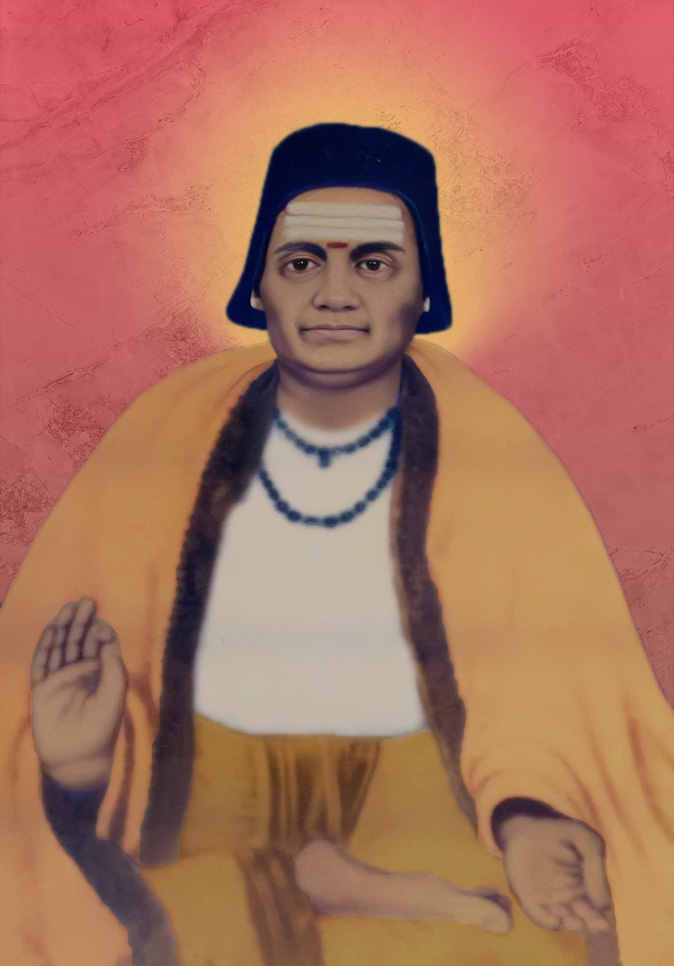
People around the world are familiar with many Sahasranamas of different Gods and Goddesses. Among them, Shree Lalitha Sahasranama stands out as the most popular and widely recited. Millions of individuals, regardless of gender, chant it both alone and in groups across India and beyond. Some devotees even repeat it multiple times a day, aiming to complete a Koti Parayanam, which involves chanting the names one crore times. Despite its popularity, only a small number truly understand the deeper meanings, connections to scripture, and the specific letters and vowels that begin the names in this Sahasranama. These unique details, along with explanations of each name from various perspectives—literary, spiritual, philosophical, and more—are beautifully detailed in ‘Saubhagyabhaskara’, the commentary on Shree Lalitha Sahasranama, regarded as a treasure of literature in this field and written by Shree Bhaskararaya.
Long ago, Shree Adi Sankaracharya wanted to create his own commentary on Shree Lalitha Sahasranama. He instructed one of his disciples to locate the original text for reference. Unfortunately, the disciple couldn’t find it. During his search, a young girl approached and handed him the Shree Vishnu Sahasranama to give to Sankaracharya. When the disciple was sent to look for the Lalitha Sahasranama again, the same situation happened twice. Eventually, Shree Adi Sankaracharya realized, through his divine vision, that the girl was actually Shree Devi. This convinced him that the task of commenting on the Vishnu Sahasranama was meant for him, especially in those times. It is also believed that this was to demonstrate his devotion to Vishnu alongside Shiva and Shree Devi. Furthermore, through his divine insight, Sankaracharya knew that the honor of writing the commentary on Shree Lalitha Sahasranama would one day go to another remarkable figure, Pujya Shree Bhaskararaya Acharya, whose story is being shared here. On June 30, 2004, Shree BHASKARACHARYA BHAKTA SAMAJAM published a book detailing the life of Pujya Shree Bhaskararaya, coinciding with the inauguration of a memorial in his honor. Very few writings from his disciples capture Shree Raya’s life. One such account is found in “Bhaskaravilasa” by Shree Umanandanatha from Tanjore, who also authored Nityotsava. Another source is “Guru Parampara” by Pandit Ramakrishna Somayaji. This has been translated into Marathi by Mahajan Sahitya Prakashan in Nanded during 1978-79, and is now being translated into Hindi by Dr. Prabhakar Sadashiv Pandit, who is related to Shree Batukanath Shastry Khistey of Varanasi.
Shree Batukanath Shastry has worked hard to publish Shree Raya’s writings, including a recent one from 1993 called “Bhaskararaya Bharati Dikshita vyaktitva Evam Krititva,” released by Sampurnananda Samskrit Vidyalay in Varanasi. An article about Shree Raya’s life can also be found in a special February 1987 edition of Kalyan magazine, focusing on Shakti upasana. His father, Shree Narayana Sastry, also wrote an introduction for Nirnaya Sagar’s Lalitha Sahasranama, which includes details about Bhaskararaya’s life. Both father and son received initiation from Shree Raghunath Shastry Godbole in Mumbai, who has done significant work to promote Shree Raya’s tradition, which stems from Shree Umapathyanandanatha, a direct disciple of Shree Raya.
Most of Shree Raya’s works are safely kept in Saraswathi Pustakalaya in Varanasi. The tradition of Shree Raya continues through Umanandanatha, who is another of his direct disciples, with practitioners like R. Krishnaswamy Shastry from Tanjore, whose family has ties to Umanandanatha. There is also a Tamil version of “Soubhagya Bhaskaram” by Shree G.V. Ganesa Iyer, and much of the information can be found in a recent book titled “Shree Lalitha Sahasranamam with Tamil commentary,” published by Jnanabhaskara Sangham in Chennai-600018.
The first known ancestor of Shree Bhaskararaya’s family is Shree Ekanatha from the Vishwamitra clan. Here are some known family members:
Grate Grand Father: Shree Tuka Deva
Grand Father: Shree Yamaji Pandit and GrandMother: Smt. Chandramamba
Father: Shree Gambhirrai Bharati -Mother: Smt.Konamba
It is confirmed by several sources that Shree Gambhiraraya and his wife Smt.Konamba were the parents of Shree Bhaskararaya. Even though Shree Gambhiraraya followed the Bhagavatha tradition, his wife learned about Agamashastra from Shree Narayana Pandita, who helped her understand this subject better. Shree Gambhiraraya worked for Bijapur Adilshahi. Following his king's wishes, he translated the entire Mahabharatha into Persian.The king honored him with the title “Bharathi” which is also noted in ‘Bhaskaravilasam’ and he was given streets in the village of Shejvali.
Shree Gambhiraraya's first son, Shree Narayana, was not as smart as his father. So, Smt. Konambika prayed to Soorya Bhagavan for another son who would be as wise as her husband. She had a very clever son around 1690 A.D. in Bhagyanagara (now called Hyderabad) in Andhra Pradesh. However, according to his students and those in his daughter’s family, the remarkable character named Bhaskara is said to have been born on April 26, 1683, during the Krittika star, in the fourth phase of the month of Vaisakha, on the third day of the bright half of the lunar month, when four planets were in strong positions.
When Shree Gambhiraraya was just 5 years old, he started worshiping Saraswati. By the time he was 7, he could recite the Sarabheshwara stotra in Kashi, which impressed the scholars and led his father to give him the sacred thread. Shree Narasimha Dori, also known as Shree Narasimhananda, a respected teacher from Lokapalli, visited Shree Raya's home on his way to Shringeri Sharada Peetha. He was amazed by the boy's sharp mind and encouraged his parents to send him to his Gurukul for schooling. Out of respect, they agreed, and Shree Raya began studying 18 different subjects.
After mastering these subjects, Shree Raya learned Gowdataraka from Shree Gangadhara Vajapeyin in Tiruvalankadu, located on the southern bank of the Kaveri River in Tanjavur district. Shree Raya chose to stay on the northern side of the river, where a place now called Bhaskararajapuram is situated. Shree Rukmanapandit then taught him about poetry and literary techniques. By the age of 16, Shree Raya had completed all his studies. He was determined to bring back the Atharvana Veda to life, so he learned it deeply and not only became skilled but also taught it to his students.
At 18, Shree Raya married Anandi, and they had a son named Panduranga. There isn't much information about him or any other children, but it’s believed that they had a daughter named Smt. Ambika, who married into the Dev family. Their lineage continues today with people living in Bangalore, Hyderabad, and other places. Shree Raya's father wanted him to join the government in the Adilshahi kingdom, but Shree Raya preferred studying scriptures, conducting rituals, writing books, and traveling. Eventually, following the guidance of his teacher Shree Narasimha Dori, he traveled to Surat to learn about Sakta and Shreevidya practices.
During Shree Raya's visit to Paithan, many scholars recommended that he seek initiation into Sakta and Shree Vidya with Shree Shivadatta Shukla. Shree Shukla was a deeply respected devotee of Shree Vidya, having undergone complete initiation under Shree Sankaracharya's path, and was known as Shree Prakashanandanatha after his Deeksha. Recognizing this, Shree Bhaskararaya set out for Surat to learn more about Shree Vidya and to receive his initiation. He approached Shree Shukla humbly, taking up the responsibilities of cleaning dishes and maintaining the household while immersing himself in the study and practice of Shree Vidya.
At that time, some learned individuals from the Vallabha tradition arrived and questioned the principles of Advaita. The followers of Advaita were at a loss and turned to the elderly Shree Shukla for guidance, as he could not travel himself. Sensing the urgency, Shree Raya asked Shree Shukla if he could lead the discussions. Recognizing Shree Raya's capability, Shree Shukla agreed. As anticipated, Shree Bhaskararaya successfully countered their arguments, returning triumphantly with the Vijay Pataka, or Flag of Victory, to Shree Shukla. Overjoyed, Shree Shukla performed a Poornabhishekha for Shree Bhaskararaya and granted him the name "Shree Bhasuranandanatha."
Shree Raya's wife also received blessings through Poornabhishekha and was given the name "Padmavathyamba." They both showed their gratitude to Shree Shukla, his wife, and their daughter by offering precious gifts and performing worship.
After receiving Poorna Deeksha from Shree Sivadatta Shukla, Shree Raya returned to home in Shejavli to spend time with his father. While there, he traveled extensively with his knowledgeable disciples, engaging in debates and emerging victorious. Interestingly, along the way, they also discussed Sastras and worked on writing books. As an Agnihotri, he performed Ishti and Yaga during their travels. He devoted himself entirely, day and night, to protecting Hindu traditions and establishing dharma. He initiated many deserving disciples into the path of worship and spread the teachings of Shree Adi Sankaracharya, particularly Advaita, engaging in discussions with various groups and winning each time.
During his travels in southern India, Acharya Sathyasraya of Madhwa Peeth challenged Shree Bhaskararaya’s tradition. In a successful response to the challenge, Shree Bhaskararaya married Sathyasraya's brother’s daughter, as agreed. He then returned to Bijapur for a while before resuming his journey. He continued to perform yagnas, build temples, arrange talks with esteemed scholars, and traveled to the banks of Krishna and Kaveri. He also granted land to Brahmins to support their daily needs. When he reached Tanjore, the King presented him with a village now called Bhaskararajapuram, where he set up a Shreechakra Meru and started regular worship. Later, Raya’s wife renovated the temple dedicated to Shree Bhaskareswara (God Siva) and Shree Anandavalli (Goddess Parameswari). Unfortunately, Shree Raya soon received news of his mother's passing, prompting his return home to fulfill the necessary rituals. Shortly after, his father also passed away.
Afterward, Shree Bhaskararaya traveled to Rameswaram, Madura-Meenakshi, and Ananthasayana, finally reaching Shreengeri. There, he met with Swamiji Shree Purushottam Bharati of Sharada Peeth, who approved his plans. He was offered items like a Chatra, Chamara, and Rajachinha, but Shree Bhaskararaya only accepted what he deemed essential. He then toured south Karnataka, visiting Mahabaleshwar and Gokarna, and reached Kolhapur, where he honored Mahalakshmi with a pooja. Throughout his journey, several kings honored him with gifts. He visited Triambakeswar, Sapthashrungi, and other temples, and when he reached Surat, he honored his guru Shree Sivadatta Shukla and his family with textiles and donations.
He continued to Somanath temple and then made his way to Kashmir, where he interacted with local scholars. His travels also took him to Omkareshwar temple, Haridwar, Pancha Prayag, and Gangotri. He went on to Nepal for Pasupati darshan, where the King and learned Pandits greeted him warmly. On his way back, he visited Ayodhya, Mathura, Kasi, Gaya, and finally arrived at Gautam Ashram, then Kamakhya Peeth, a place shrouded in fears due to black magic. The locals welcomed Shree Bhaskararaya, and he performed pooja at the Kamakhya temple. He then traveled to Nagpur, Marathwada, Jyothirling, Nagnath, Parli-Vaidyanath, and concluded at Thulaja Bhavani in Thulajapur. As his ancestors were followers of Pandaripur Vitthala, he visited there to offer his prayers and composed the Pandurangashtaka. He also went to Sannathi Kshetra in Gulbarga District, Karnataka, where he built the Shree Chandralaparameshwari temple in honor of his Kuladevatha and arranged for daily worship and support for the Brahmins. During this time, he wrote another work titled “Chandralashtaka.”
According to Srri Panashikar Vasudev Sharma’s introduction to Nirnaya Sagar’s Shree Lalitha Sahasranama Bhashya, an intriguing event took place in Kasi during the writing of Saubhagyabhaskara. The scholars in Kasi decided to challenge the teachings of Shree Bhaskararaya and, led by Shree Narayana Bhatta, approached him for a debate. Shree Bhaskararaya welcomed them and organized the discussion. He answered all their questions, but the group believed they could win by asking about mantra shastra, which he was well-versed in. They demanded a list of the names and details of 64 crores of Yoginis mentioned in the 237th name, "Maha chathusshashti koti yogini gana sevita" from the Shree Lalita-Sahasranama.
Shree Bhaskararaya agreed to the challenge and asked them to meet him by the Ganga River at Chaoushashti ghat that evening. He sat in meditation and encouraged the scholars to write down the names and details. To their surprise, all two hundred participants began writing different names without stopping. Eventually, exhaustion set in, with tired hands, but for Shree Bhaskararaya, the flow of names seemed endless. Observing this, Shree Kumkumadi Saraswathi, a learned sanyasi present, realized that Shree Devi was speaking through Shree Bhaskararaya. He urged Narayana Bhatta to accept defeat. Initially reluctant, Shree Narayana Bhatta wanted proof. So, Kumkumanandanatha took water from where Shree Devi was bathed and anointed Narayana Bhatta’s eyes. Instantly, he witnessed Shree Devi on Shree Bhaskararaya’s shoulders, speaking through him. Understanding the truth, Shree Bhatta joined Shree Bhaskararaya’s tradition. The Choushashti ghat in Kasi remains to this day.
In his later years, Shree Bhaskararaya stayed at Madhyarjuna Kshetra, which is today known as Thiruvidaimarudur, in his residence called Bhaskara Nilaya on Mahadana Street. Every evening, he would sit on the porch of his house, resting his legs against the pole, while teaching his disciples. During this time, a sanyasi from Veppattur would pass by on his way to the Mahalingeshwar temple. Shree Bhaskararaya did not acknowledge the sanyasi. The sanyasi objected during a pradosha pooja at the temple, and Shree Bhaskararaya responded and requested him to keep his stick away, which broke into pieces upon that request. As a Shreevidya Poornabhishekha deekshita with powers from Mahapaduka, Navavarana Pooja, and Mahashodanyasa, Shree Bhaskararaya did not feel the need to bow to anyone. To uphold the respect for the sanyasi community, he decided to avoid any confrontation by stepping inside his house.
Shree Chandra Sen was a general in the Maratha kingdom. Due to political issues with the Maratha Maharaja, he had to leave with some sardars and sought refuge with the Nizam, who provided him a place called Bhalki. During that time, Shree Chandra Sen came under the influence of a fakir, who drove him to madness for refusing to convert to Islam. By chance, Shree Bhaskararaya was on a pilgrimage to Bhalki and learned about Chandra Sen’s plight from his wife. Shree Bhaskararaya prayed and arranged for Bhagavathi Dandanayika through Vedic scholars, which restored Chandrasen’s sanity and caused the fakir to flee.
The queen of Chandra Sen, who was pregnant, asked Shree Narayana Maharaj, a devoted disciple of Shree Bhaskararaya, whether she would have a male or female child. He predicted a girl. Later, Shree Bhaskararaya visited, and the queen posed the same question, hoping for a different answer. Shree Bhaskararaya claimed she would have a boy (some versions suggest the order is reversed). The queen pointed out the conflicting predictions. Annoyed, Shree Raya insisted that Narayana Maharaj’s words, being a great sage and his disciple, could not be wrong, nor could his own prediction. Consequently, she gave birth to a frail child with no significant growth, who was neither distinctly male nor female.
Years later, Shree Raya returned, and Chandra Sen asked him to help his child. Shree Raya meditated on Soorya Bhagavan by the Krishna River to heal the child. While there, he needed to go to the riverbank for daily rituals, and his disciples sought a solution to this inconvenience. Jokingly, Shree Bhaskararaya suggested asking the river Krishna to flow their way instead of making the trek every day. His disciples, though surprised, had immense faith in his abilities and insisted he perform this feat. Shree Bhaskararaya prayed to Soorya, making the impossible request a reality. His prayer and offerings were later recorded in a work called “Trichabhaskara.” The area is known today as Moolimadu, meaning a turning point for water flow in Kannada, and it is now called Moolamalla in Andhra Pradesh. In Bhaskaravilasam, it is referred to as Moolahruda.
Shree Bhaskararaya established his headquarters in a village gifted to him by King Bhonsle of Tanjore, becoming known as Bhaskararajapuram. Throughout his life there and in nearby areas, tales of his spiritual prowess and miraculous acts spread. Towards the end of his life, he is believed to have resided in Tiruvidaimarudur, in a house called “Bhaskara Nilayam” on Mahadana Street, close to Bhaskararajapuram. According to his disciples and family, he passed away in 1776 on Ashadha Sukla Trayodasi at the age of 93 (though some accounts suggest 1785 at age 95). There are countless significant events, many of which remain unknown to us but are familiar to others who may share them.
This site is located in the northern part of Karnataka, specifically in the Bijapur Adilshahi area, close to Kharepatan in the Ratanagiri district of Maharashtra. It was once the home of Shree Bhaskararaya’s parents, making it an important place for both history and spirituality. Here, you'll find the Shree Gambhirehwar Shiv Temple, which has been around for over 300 years and is where Bhaskararaya started his spiritual journey. The Pooja Ghar of Shree Bhaskararaya is still preserved, and his descendants, now in the eighth generation, continue to live there. A trust has been set up to ensure that this sacred site is well cared for.
A village located in the Gulbarga district of northern Karnataka, near the Nalwar railway station along the Bombay-Madras line, between Raichur and Gulbarga. Here lies Shree Chandralaparameshwari Devastanam in ShreeChakrakara, which was built by Shree Bhaskararaya.
This small village near Tiruvalankadu in the Tanjavur district of Tamil Nadu was given to Shree Bhaskararaya by the King of Tanjore. Shree Raya’s wife, Smt. Padmavati, built the Shree Anandavalli sameta Shree Bhaskareswara Alayam there, installing the deities Goddess Shree Parvathi and God Shree Parameshwara in the form of a Shiva Linga. The temple underwent a Kumbhabhishekam in 1979 under Shree Kanchi Sankaracharya's guidance, and another renovation was celebrated on August 26, 2002.
Once known as Madhyarjuna, this town is home to a large temple featuring an ancient Shiva Linga that is about 2000 years old. The road leading to the temple is called “Mahadana Rasta.” Just half a kilometer down this road, you’ll find “Bhaskara Nilayam,” where Shree Raya spent his later years. The temple also houses a significant statue of Shree Bhaskararaya and a large golden Shree Chakra.
This is a taluk in Bidar district, Karnataka, where Shree Umapathyanandanatha, a direct disciple of Shree Bhaskararaya, is from. Shree Bhaskararaya frequently visited this area. You can see the samadhi of Shree Umaapatyaanandanatha here.
Here, Shree Bhaskararaya triumphed in debates and performed miracles related to Chatusshashti Koti Yogini darshanas at Chousatti Ghat. He also wrote a commentary on Ganesha Sahasranama at Trilochana Ghat.
Found in Gujarat, Surat is where Shree Shivadatta Shukla, also known as Prakashanandanatha, introduced Shree Bhaskararaya to Sakta Upasana and gave him the sacred initiation of Shreevidya Poornabhisheka.
A town situated in Nanded district, where the legacy of Shree Umapathyanandanatha continues with a mutt named Shree Shukananda mutt. The current head, Shree Chintamani Siddha Maharaj, carries on this tradition.
The full name is Bhagyanagara, which is now known as Hyderabad in Andhra Pradesh. It's where Shree Bhaskararaya was born.
This village is located about 3 kilometers from Narayanpet. It’s here that Shree Bhaskararaya learned 18 different arts from his teacher, Shree Narasimha Dhvari.
This is a railway station on the Bombay-Madras line, situated between Raichur and Gulbarga stations, about 40 kilometers away. Shree Bhaskararaya’s daughter lived in the Dev family here after her marriage. The Dev family, descendants of her, still reside in the area, with some having moved to Hyderabad for work. The samadhi of Shree Vitthala Dev (Shree Dheeranandanatha) is also here, and in 1970, the padukas of Shree Bhaskararaya were installed there. Shree Subhaganandanatha, a guru and father of Shree Anilkumar Nagarkatty from Bangalore, lived in this location too.
Known today as Moolamalla, this village is in the Atmakur Taluk of Mahaboobnagar district, Andhra Pradesh, about 11 kilometers from Atmakur by bus. Located by the Krishna river (referred to as Moolahruda in Bhaskaravilasam), Shree Bhaskararaya constructed the Shree Vitthala temple, honoring his family deity, as indicated by the sloka on the temple door frame.
Shree Umanandanatha, who was a direct disciple of Bhaskararaya and known as Shree Jagannatha Pandita from the Vishwamitra Gotra, wrote a work called "Bhaskaravilasam." This poem shares the life story of his teacher. In the sections from 42 to 69, he details the various books authored by Bhaskararaya. His well-known works on Shreevidya, collectively called "Prasthana thraya," include Varivasya Rahasya, Saubhagya Bhaskara, and Setubandha. (There's a fascinating story about Chousatti Ghat related to one of these books, which will be discussed in another chapter.)
Umanandanatha also made contributions to Vedanta with works like Chandabhaskara and Neelakalakapetika. In the area of Mimamsa, he wrote Vadakauthuhala, Bhatta Chandrodaya, and Rasikaranjani, which comments on Madhya Siddhanta Kaumudi related to grammar. Early in his life, he produced Chandobhaskara and Chandahkausthubha, along with other prose pieces such as Vrittachandrodaya, Vaarthikaraja, and Mruthasanjivini. His poetry includes works like Chandrashala, Madhuramala, and Bhaskara Subhashitha. When it comes to smriti, he authored Smrititatva, Sahasra Bhojana Kanda Tika, Shankhachakrankana prayaschitta, Ekaadasi nirnaya, Pradosha nirnaya, Trichabhaskara, and Kundabhaskara. His devotional hymns are Sivastava, Devistava, Shivadandaka, Shivastotra, and Shiva Satanamastotra vyakhya. He also compiled Vedic terminology in a glossary called Vaideeka kosha.
1. Khadyotha - commentary on Ganapati Sahasranama
2. Chandralamba Mahatmya tika
3. Nadanavaratnamala Manjoosha
4. Bhavanopanishad Bhashya
5. Sree Sookta Bhashya
6. Kaulopanishad Bhashya
7. Thripuropanishad Bhashya
8. Soubhagya Chandrodaya
9. Tripurasundari Bhashya Varivasya
10. Ratnaloka - commentary on Parasuramakalpasutra
11. Guptavati - commentary on Durgasaptasati
12. Satasloki
13. Malamantroddhara
1. Avadhoota Geeta Vyakhya
2. Ashtavakra Geeta Vakra Vyakhya
3. Atmabodha Vyakhya
4. Amnayapaddhati
5. Eshwara Geeta Vyakhya
6. Kathopanishad Bhashya
7. Kenopanishad Tika
8. Taitiryopanishad Tika
9. Jabalopanishad Bhashya
10. Uttara Varivasya