
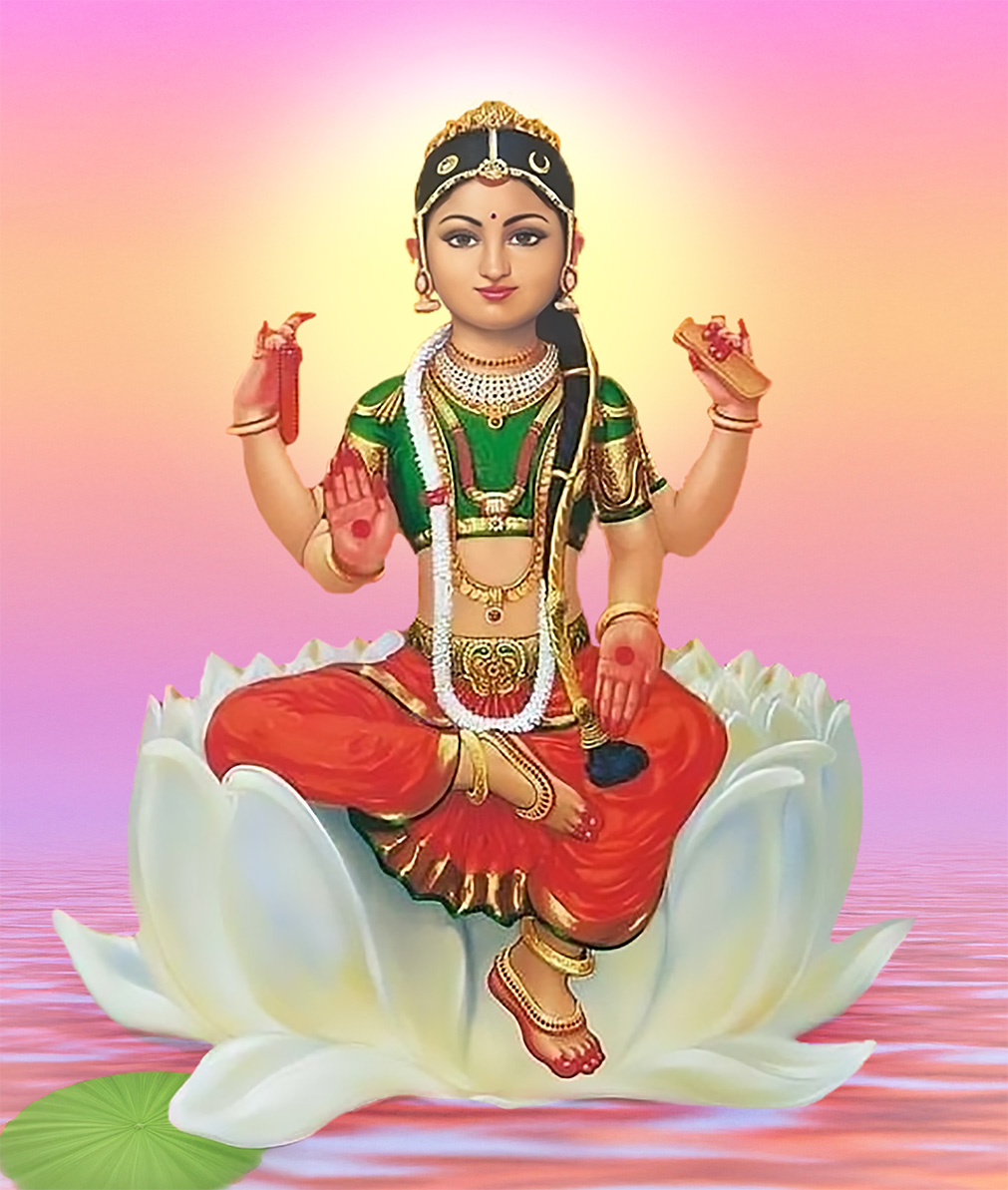
In the context of Shree Vidya, Bala Tripura Sundari(Balambika) Devi holds a unique and significant position, as she represents the youthful and vibrant energy of the Divine Mother. Shree Vidya, being a spiritual tradition rooted in the worship of the Supreme Divine Feminine, aligns beautifully with the qualities attributed to Bala Tripura Sundari(Balambika). Here's how she is connected to Shree Vidya:
- Balambika is often regarded as a form of Bala Tripura Sundari, the child aspect of Tripura Sundari, who is the presiding deity of Shree Vidya.
- As Bala, she represents innocence, purity, and the foundational knowledge necessary for deeper spiritual practices.
- In the Shree Vidya tradition, Bala is considered the starting point for aspirants.
- Worshiping Bala helps practitioners establish a connection with the Divine Mother in her simplest and most approachable form before progressing to the more complex worship of Tripura Sundari.
- As in other depictions, Bala Tripura Sundari(Balambika) in Shree Vidya is shown as a child goddess with divine attributes like holding a book (symbolizing spiritual wisdom) and a rosary (denoting meditation and japa).
- She embodies the essence of the Bija Mantras that form the core of Shree Vidya practices.
- Bala’s childlike nature symbolizes a beginner's mind, which is crucial for spiritual learning.
- She grants her devotees not just academic knowledge but also inner wisdom and insight into the esoteric teachings of Shree Vidya.
- Bala Tripura Sundari(Balambika)'s energy is said to preside over the outer triangles of the Shree Chakra, the sacred geometric representation of Shree Vidya.
- Devotees often invoke her blessings for guidance in navigating through life's challenges and gaining access to higher levels of consciousness.
- The Bala Mantra is a key aspect of Shree Vidya practice and is often one of the first mantras given during initiation.
- Worship of Bala Tripura Sundari(Balambika) is accompanied by offerings, recitation of her mantras, and meditating on her youthful yet powerful form.
In Shree Vidya, Bala Tripura Sundari(Balambika) Devi represents the beginning of spiritual awakening. Her worship allows the practitioner to develop a foundation of purity, humility, and devotion. She nurtures the aspirant's journey toward the ultimate realization of the Divine Mother as Tripura Sundari.
If you're exploring Shree Vidya practices or wish to incorporate Bala Tripura Sundari(Balambika) Devi's worship into your spiritual life, We can guide you further.
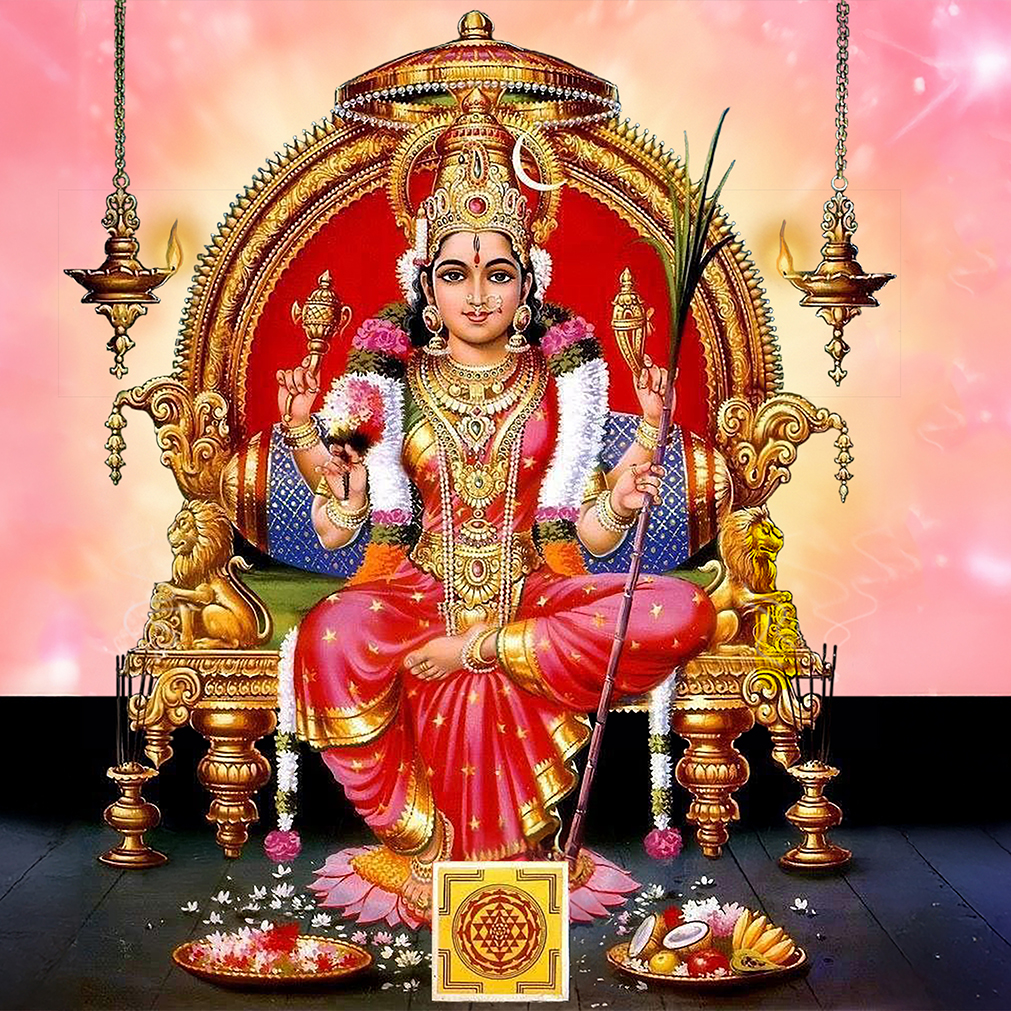
In the Shree Vidya tradition, Rajarajeshwari Lalita Tripura Sundari is revered as the Supreme Goddess, embodying the ultimate creative, sustaining, and transformative power of the cosmos. She is the central deity of Shree Vidya Upasana, and her worship is considered the highest form of devotion and spiritual practice within this esoteric tradition.
- Rajarajeshwari means "The Sovereign Queen of Kings." She is the ruler of the entire universe and the epitome of grace, beauty, and power.
- Lalita translates to "The Playful One," symbolizing her dynamic, spontaneous, and joyful nature in creating and sustaining the cosmos.
- Tripura Sundari signifies "The Beautiful One of the Three Worlds" (physical, subtle, and causal), uniting them within her.
- She is the ultimate form of Shakti, representing Para Shakti, the supreme power beyond all manifestations.
- Rajarajeshwari is both the motherly nurturer and the cosmic ruler, guiding devotees toward enlightenment and liberation.
- The Shree Chakra, or Shree Yantra, is the geometric representation of Rajarajeshwari.
- Each layer of the Shree Chakra corresponds to her divine energies, guiding devotees from the outermost material world to the innermost Bindu, where she resides as pure consciousness.
- Worship involves Abhishekam (ritual bathing), Archana (offerings), and meditation on the yantra.
- Her primary mantras include the Panchadasi Mantra (15 syllables).
- These mantras encapsulate the essence of Shree Vidya and are powerful tools for connecting with her divine presence.
- She is the integration of Ichha Shakti (willpower), Jnana Shakti (knowledge), and Kriya Shakti (action).
- In this trinity, she governs creation, sustenance, and dissolution.
- Rajarajeshwari is considered the Adi Guru (first teacher) who imparts the highest wisdom.
- Worshiping her through Shree Vidya practices allows devotees to access this divine knowledge and transcend duality.
- Rajarajeshwari represents the unity of Shiva and Shakti. She is the ultimate reality where the distinction between the individual self and the universal self dissolves.
- The realization of her presence within oneself is the culmination of Shree Vidya.
- As Lalita, she represents the leela (divine play) of creation. While appearing as the manifested universe, she remains untouched and transcendent.
- Rajarajeshwari is celebrated for her karuna (compassion) and anugraha (grace). It is believed that her blessings remove obstacles, bestow prosperity, and lead to liberation.
- Worshipers perform rituals with flowers, lamps, incense, and offerings, meditating on the Shree Chakra to invoke her blessings.
- Each segment of the Shree Chakra is meditated upon, honoring her various forms and attributes.
- The Lalita Sahasranama (1,000 names of the Goddess) is a central text that praises her divine qualities and powers.
- Chanting her mantras with devotion leads to inner transformation and the awakening of higher consciousness.
- Navaratri and Lalita Panchami are significant occasions for her worship.
The ultimate goal of worshiping Rajarajeshwari Lalita Tripura Sundari is to:
1. Attain Atma Vidya (Self-Knowledge) and realize one’s unity with the Divine Mother.
2. Transcend material limitations and experience Moksha (liberation).
3. Merge with the Bindu of the Shree Chakra, symbolizing complete union with the infinite.
By engaging with her worship, a practitioner moves from the duality of the material world toward the non-dual experience of pure bliss and consciousness. Let us know if you'd like detailed guidance on Shree Chakra meditation, mantra chanting, or any other aspect of her worship!
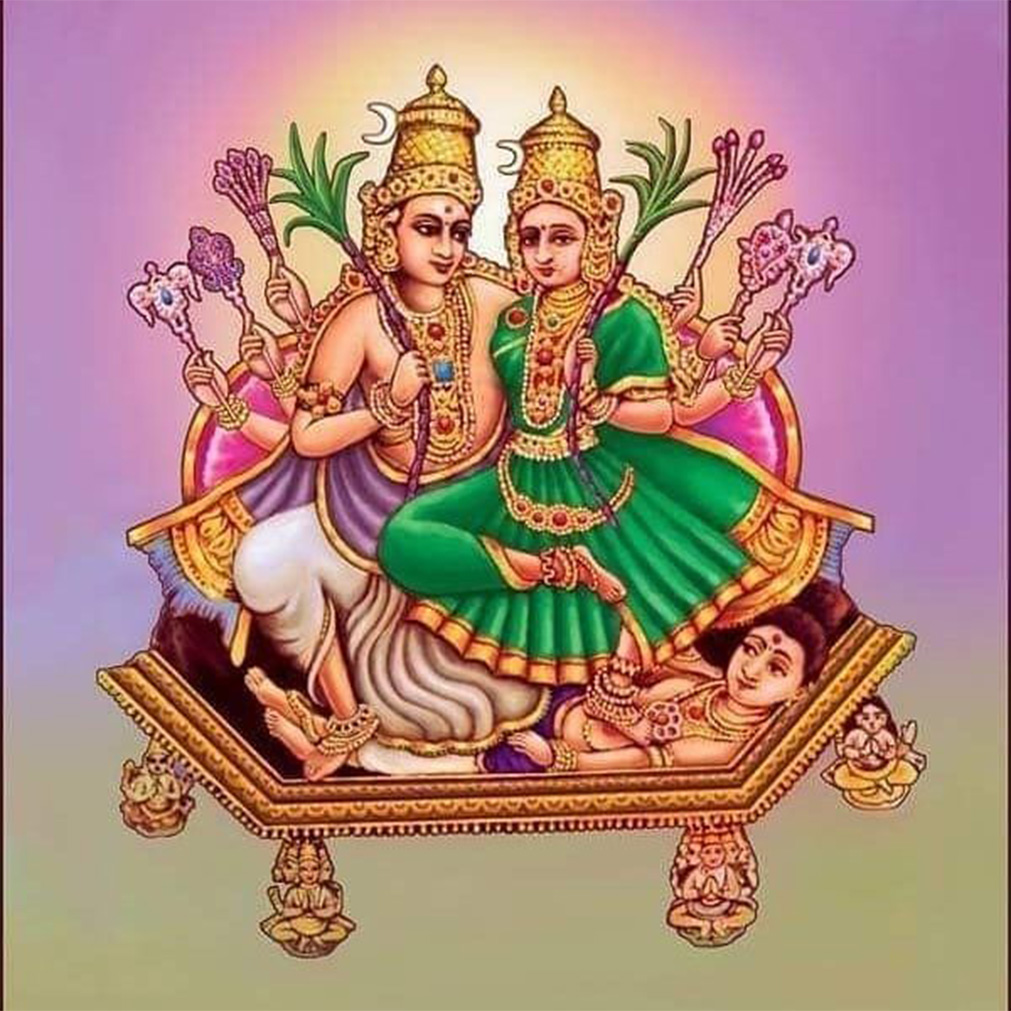
In the Shree Vidya tradition, Shodashi (also known as Lalita Tripura Sundari) is a central and highly revered form of the Divine Mother. Her name, Shodashi, means "The One Who is Sixteen," symbolizing perfection, completeness, and the transcendence of time and space. She represents the full manifestation of Shree Vidya, where the aspirant merges with the ultimate reality through devotion, meditation, and self-realization.
- Shodashi is the mature and radiant form of Tripura Sundari, the goddess of beauty, wisdom, and the three worlds (physical, subtle, and causal).
- She is the Adi Parashakti, the ultimate cosmic power that creates, sustains, and dissolves the universe.
- The number sixteen symbolizes completion and fulfillment in various contexts:
- The 16 syllables of the Shodashi Mantra (a highly potent and sacred mantra in Shree Vidya).
- The 16 phases of the moon, representing the cyclical nature of time and its transcendence.
- The 16 Kalas (arts or qualities) that signify divine perfection.
- Shodashi is the deity presiding over the Bindu (central point) of the Shree Chakra, symbolizing the ultimate union of Shiva and Shakti.
- She represents the culmination of spiritual practice, where the devotee experiences Advaita (non-duality) and realizes their oneness with the Divine.
- Shodashi is depicted as a youthful and resplendent goddess, radiant like the rising sun.
- She has four arms, holding:
- A sugarcane bow, symbolizing the mind.
- Five flower arrows, representing the five senses.
- A noose (pasha), signifying attachment.
- A goad (ankusha), symbolizing control over desires.
- She sits on a throne supported by Brahma, Vishnu, Rudra, Ishwara, and Sadashiva, signifying her supremacy over all cosmic forces.
- She is often shown adorned with a crescent moon on her forehead and seated at the center of the Shree Chakra, radiating divine energy.
- Also known as the Shodashakshari Mantra, it consists of 16 syllables and is considered one of the most powerful mantras in Shree Vidya.
- The mantra represents the universe's essence, and its recitation awakens the kundalini energy and aligns the practitioner with the Supreme Consciousness.
- Shodashi resides in the innermost Bindu of the Shree Chakra.
- Meditating on the Shree Chakra helps the aspirant transcend the material world and experience union with the Divine Mother.
- Tripura means "of the three cities" and represents the three states of consciousness:
- Waking (Jagrat)
- Dreaming (Swapna)
- Deep Sleep (Sushupti)
- Shodashi is the guiding force that transcends these states to reach Turiya, the fourth state of pure awareness.
- Shodashi embodies the perfect union of Shiva (pure consciousness) and Shakti (creative energy), representing the non-dual reality.
- She is the central focus of Shree Vidya Tantra, which integrates ritual worship, meditation, and mantra practices to awaken spiritual potential.
- Worshiping the Shree Chakra involves offering flowers, mantras, and devotion to each layer of the yantra, culminating in the worship of the Bindu, where Shodashi resides.
- The Lalita Sahasranama (1,000 names of the goddess) is a hymn of praise describing her divine qualities and cosmic role.
- Regular chanting of the Shodashi Mantra is considered a means to awaken spiritual energy and align with her grace.
- Preparing the body and mind through purification rituals to receive the transformative energy of Shodashi.
- Through Shodashi's grace, practitioners move beyond the dualities of pleasure and pain, life and death, to experience Advaita (oneness).
- The ultimate goal is liberation, where the soul realizes its eternal nature and merges with the Divine Mother.
- Shodashi's worship brings alignment with the universe, ensuring prosperity, wisdom, and inner peace.
By invoking Shodashi, the practitioner embarks on a journey to discover their true self, experiencing the bliss of the Divine Mother in her most radiant and complete form. Let me know if you'd like detailed guidance on Shree Chakra meditation, the Shodashi Mantra, or rituals specific to her worship!